
Thursday, August 20, 2026
How to batch-pay vendors, contractors and teams in stablecoins
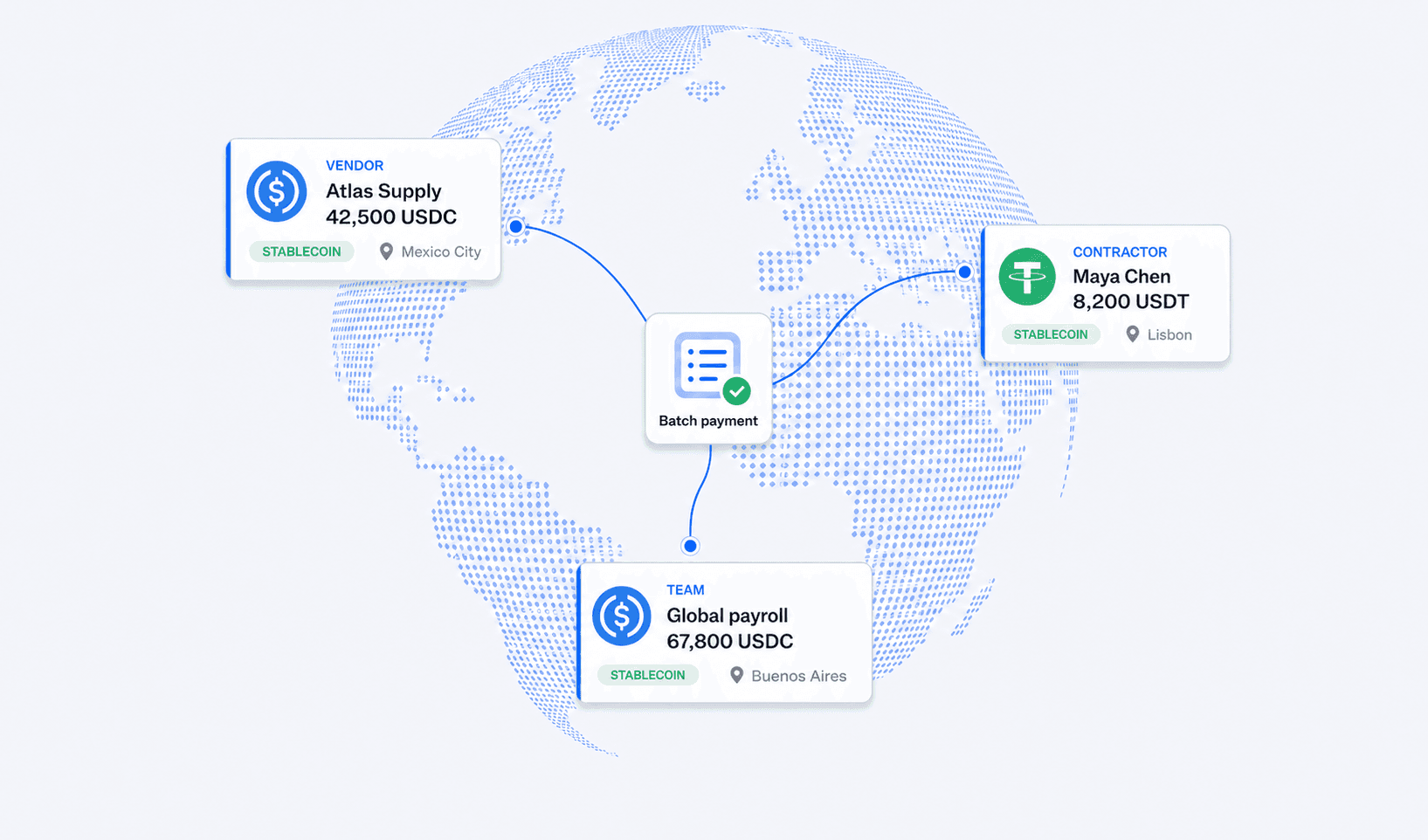
If you have ever spent an afternoon triple-checking wallet addresses before sending 60 separate transfers, you already know why crypto mass payments is one of the fastest-growing search terms among finance teams. A crypto mass payment, also called a batch stablecoin payment, is a single transaction or single approval flow that pays many recipients at once in a stablecoin like USDC or USDT, instead of processing each payout one by one. For companies paying vendors, contractors, or distributed teams every month, that difference is the gap between a few minutes and two days.
This guide breaks down why finance teams are moving mass payouts to stablecoins, how to set up and run a batch payment, and what to watch out for on compliance, reconciliation, and security. We use Request Finance throughout as the reference platform, since batch stablecoin payments are one of its core use cases. For a platform-by-platform comparison of ten tools in this category, see our crypto mass payments platforms compared guide.
Why paying one by one stops working around your 20th recipient
Fees stack with every payout. Wire fees, card markups, and FX spreads apply per transfer, not per batch. Pay $100,000 to 80 freelancers through traditional rails and you are looking at 3% to 8% all-in on many corridors. That is $3,000 to $8,000 gone before anyone receives a cent, and it scales linearly with headcount.
Manual data entry creates errors. Copy-pasting IBANs, wallet addresses, and amounts across 80 rows is where mistakes happen: wrong account numbers, duplicate payments, missed recipients. Each error costs time to investigate and trust to repair.
Speed depends on banking hours. International wires typically take 2 to 5 business days. Send on a Friday and your contractor in Manila may not see funds until the following week. Cutoff times, correspondent banks, and holiday calendars all add delay you cannot control.
Reconciliation becomes a second job. Eighty transfers means eighty bank confirmations to match against eighty invoices or payroll lines. Your accountant spends days closing the month instead of analyzing it.
Stablecoins solve the settlement problem: transfers that settle in minutes, any day of the week. Batch tooling solves the operations problem: one CSV upload, one review screen, one approval, and every recipient paid.
What counts as a crypto mass payment
A crypto mass payment is a single batch operation that pays multiple recipients from one funded balance, using stablecoins as the settlement rail. You upload a recipient list, review the totals, approve once, and execute. The platform handles routing each payout to the correct wallet or bank account.
This is different from sending individual P2P transfers from a personal wallet, where you repeat the same steps manually for every payee with no approval layer, no audit trail, and no accounting integration.
It is also different from crypto payroll platforms built around employment compliance. Mass payments cover vendors, affiliates, creators, and contractors who invoice you or appear on a payout list. They do not require payslips, employment contracts, or EOR infrastructure. If your use case is paying salaries with full HR compliance, see our crypto payroll guide. If your use case is paying many recipients at once, mass payments are the right frame.
How to batch-pay vendors, contractors and teams with Request Finance
1. Open a [Business Account](https://www.requestfinance.com/products/business-account) and complete KYB. Verification runs when you activate your business account and usually takes a few days. Once approved, you can fund the account via wire, stablecoin top-up, or client collections.
2. Load or import your recipient list. Upload a CSV with payee names, amounts, and payment details, or pull from existing invoices in your accounts payable workflow. No need to create individual invoices for every direct payment if your process does not require them.
3. Choose the payout rail per recipient. Each payee can receive USDC, USDT, or local currency via bank off-ramp. You set the method once per recipient and reuse it every month. Request Finance supports payouts to 190+ countries.
4. Route the batch through an approval workflow. Define who prepares, reviews, and approves before funds move. On Growth tier and above, multi-step approval policies apply to every batch, so no single person can send 200 payments alone.
5. Review once, then execute in one click. The platform shows a single summary: total amount, recipient count, and rail breakdown. Confirm, and every payout fires in the same execution. Stablecoin payouts are free; fiat off-ramps carry a flat 0.5% fee.
6. Let recipients track their own payment status. Recipients see when a payment is sent and when it lands. You stop fielding "did it go through?" messages every month.
7. Reconcile automatically. Every payment is logged with a reference, exportable to CSV, and synced to QuickBooks Online or Xero on Growth tier and above. Your month-end close matches payments to invoices without manual spreadsheet work.
Finance teams using Request Finance for batch payouts report closing payment cycles 2.4x faster than with legacy AP software and manual bank transfers.
A real example: cutting payroll fees from 8% to under 0.5%
A Florida-based recruitment and sourcing company places 80 to 100 freelancers from Latin America every month. With operations across the US and Canada and over $100,000 in monthly freelancer payroll, stablecoin payouts had become essential, but the process of getting there was anything but efficient.
To pay freelancers in USDT, the team was converting USD through Binance P2P. Fees regularly reached 8%, and every transaction required back-and-forth negotiation. There was no central system to manage payroll, track payment status, or handle USD and CAD to stablecoin conversion at scale. Each month meant manual work, unpredictable costs, and zero visibility into what had actually been paid.
The company onboarded onto Request Finance and funded their Business Account with a single wire transfer. From there, they pay all freelancers in USDT directly to their wallets each month, at an onramp fee of 0.3%, down from up to 8% on Binance P2P.
No more negotiations. No more manual conversions. One account, one transfer, 100+ payments in two clicks.
The results: payment fees reduced from up to 8% to under 0.5%, $100K+ in monthly stablecoin payroll processed through Request Finance, 100+ payments per month to LATAM freelancers completed in seconds, and full AP visibility with invoice management and approval workflows.
Batch stablecoin payments vs traditional payout methods
Payout method comparison
Batch stablecoin payments vs traditional payout rails
| Capability | Request Finance | Wire transfer | PayPal / cards | Exchange P2P |
|---|---|---|---|---|
| Settlement time | Seconds, 24/7 | 2-5 business days | 1-4 days, holds common | Minutes to hours, manual |
| Cost per payout | Free stablecoin, 0.5% fiat | Flat fee + FX, 3-8% all-in | 2-5% + conversion | Spread-dependent, opaque |
| Batching hundreds of payouts | CSV upload, one click | Manual or costly add-ons | Limited, fee-heavy | Not built for it |
| Approval workflows | ✓ | Portal dependent | Minimal | ✗ |
| Reconciliation | Auto-synced | Manual matching | Manual export | Spreadsheet-based |
| Recipient visibility | Real-time on-chain | Waits for confirmation | Delayed notifications | ✗ |
| Coverage | 190+ countries | Bank network dependent | Region-restricted | Exchange-dependent |
Security and compliance before you batch-pay at scale
Wrong-address risk. Blockchain payments are irreversible. A typo in a wallet address means lost funds. Request Finance avoids this by having payees register their own payment details on their account. You select from verified records instead of copy-pasting addresses from a spreadsheet.
KYB and AML on your entity. Before you send at scale, your company completes verification. That also means your counterparties on Request Finance are verified, which gives your auditors a cleaner paper trail than paying through unverified P2P channels.
Audit trail. Every batch payment is timestamped, attributed to an approver, and linked to supporting documents. Export the full history for your accountant or auditor without reconstructing it from bank statements.
Accounting treatment. Stablecoin payouts are recorded like any other vendor payment. The stablecoin is the settlement method, not a trading position. Confirm specifics with your accountant, especially for foreign-held asset reporting in your jurisdiction.
Who actually uses crypto mass payments
Affiliate and performance marketing networks paying hundreds of partners across dozens of countries every month, where wire fees per payout make weekly settlement impractical.
Creator and influencer agencies running batch payouts to 40, 60, or 100+ contractors who expect fast, reliable payment in USDC or local currency.
Global staffing and contractor payroll for companies with distributed freelancer rosters in LATAM, Southeast Asia, and Africa, where traditional banking is slow or expensive.
Marketplaces and commission-based businesses settling seller or partner earnings in bulk after each billing cycle.
The common thread: high recipient count, cross-border corridors, and a finance team that needs one workflow instead of five tools.
Frequently asked questions
How many recipients can I pay in one batch?
There is no practical cap for most use cases. Request Finance handles batches from a handful of vendors to hundreds of affiliates in a single execution. Upload your CSV, review, and pay everyone at once.
Do recipients need a crypto wallet?
Not necessarily. Recipients can receive stablecoins to a wallet address or local currency to a bank account through the off-ramp. You pay in stablecoins from your Business Account; what lands on the other side depends on what each payee chose.
What stablecoins are supported?
USDC and USDT cover the vast majority of mass payment use cases. Recipients choose their preferred stablecoin and blockchain when they register their payment details.
Is batch paying in stablecoins compliant?
Yes, when you use a verified platform with KYB on your entity and proper record-keeping. Stablecoin payouts to contractors are a settlement method agreed between two businesses, similar to a wire. Confirm jurisdiction-specific rules with your counsel.
How is this different from crypto payroll?
Crypto payroll focuses on paying employees and contractors with HR compliance context. Crypto mass payments focus on paying any list of recipients at scale: affiliates, creators, vendors, or partners. See our crypto payroll guide for the salary use case.
What does it cost?
Stablecoin payouts are free on every Request Finance plan. Fiat off-ramps carry a flat 0.5% fee on Growth tier and above. Subscription pricing starts at $50/month; the Growth plan at $250/month billed annually includes batch payments, approval workflows, and accounting integrations.
Getting started
Batch payments, approval workflows, and QuickBooks or Xero sync live on the Growth plan at $250/month billed annually. That covers unlimited outgoing transactions, batch payouts to hundreds of recipients, and the reconciliation tooling that makes mass payments viable at scale.
Book a demo to walk through a batch payment with your own recipient list, or explore the mass payouts feature and start your 30-day free trial.