
Thursday, August 20, 2026
Crypto payroll: how to pay your global team in stablecoins
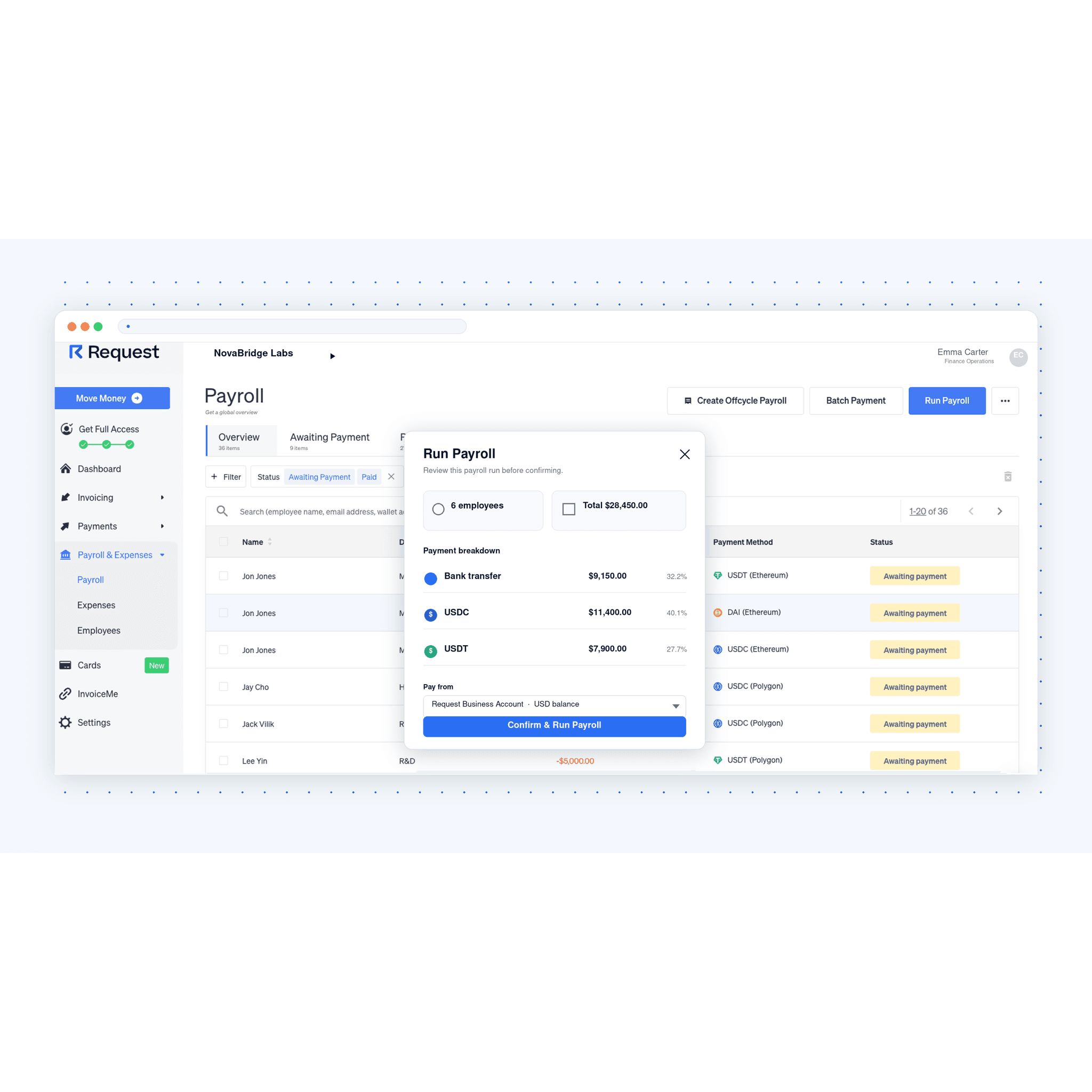
Crypto payroll is becoming more important every year. Teams are remote and spread across the world, and salary payments face the same problems as cross-border B2B payments: slow wires, high fees, FX spreads, and banking systems never designed for a team distributed across 15 countries. Team members are often in regions where banking services are limited and cannot receive currencies other than the local one. Solutions like Wise are not available everywhere, which forces finance teams to juggle several tools. Stablecoin payments solve a large part of this. This article explains what crypto payroll is in practice, how it works, and answers the questions finance teams ask us most.
What crypto payroll actually means
Payroll covers two different things: payroll management (payslips, contracts, compliance) and payroll in the sense of actually paying salaries. Crypto payroll concerns the second. It uses stablecoins, mostly USDC and USDT, as the rails to move money from the company to the people. It does not replace your HR tool, your employment contracts, or your local compliance obligations. It replaces the wire.
Important clarification: paying in stablecoins does not mean your team receives stablecoins. You send USDC, and the recipient gets USDC, euros, dollars, or local currency, depending on what they need. The stablecoin is the transport layer. What lands on the other side is a choice.
How it works
1. Fund the [Business Account](https://www.requestfinance.com/products/business-account). Client payments or a treasury transfer land in the account. Fiat is converted to stablecoins at the moment of funding, so you never hold crypto on your balance sheet beforehand unless you choose to.
2. Prepare the batch. Import your payee list or receive contractor invoices. Each payee sets their own payout method: stablecoin wallet, local bank account, or another supported rail.
3. Validate and execute. One review, one approval flow, one execution. Whether you are paying 5 people or 200, the process is the same.
4. Reconcile. Every payment is logged, exportable, and matched to an invoice or payroll line. Your accountant gets the same paper trail they would from a wire batch.
Paying contractors across borders
The international contractor use case is where crypto payroll delivers the most value: the developer in Argentina, the designer in Brazil, the support agent in the Philippines.
Take a concrete example: 20 contractors across Latin America, Africa, and Southeast Asia. With classic wires, you pay $20 to $50 per payment in fees, plus FX spread, plus 2 to 5 days of delay, plus failed payments to investigate, every month. With stablecoins, you run one batch payment, settlement takes minutes, and total fees come to a few dollars.
There is also the contractor's perspective. In high-inflation countries, being paid in a currency that loses value is a real problem. Many contractors in Argentina or Nigeria actively ask to be paid in USDC or USDT so they can hold dollars and convert locally when they choose.
For the finance team, the amount due stays defined in the contract currency. The stablecoin is only the settlement method, like a wire. If the contractor receives stablecoins, that should be written in the agreement. The invoice remains the supporting document, and the payment is booked like any other contractor payment. Some jurisdictions have specific rules, so confirm with your accountant.
Do my contractors need a crypto wallet?
Not necessarily, and this is the most common misconception.
If they want stablecoins, yes, they need a wallet address. That takes minutes to set up and costs nothing. Most contractors asking for stablecoin payments already have one, often an account on a local exchange that gives them both an address and a path to convert locally. The contractor chooses the blockchain, which is handled automatically with the Request Business Account.
If they prefer fiat, they need nothing crypto-related at all. They provide bank details like for any wire, and the off-ramp handles the conversion. You pay in stablecoins, they receive pesos, reais, or euros in their normal bank account.
This per-payee flexibility is what makes the model work at scale. In a team of 30, some want USDC, some want local currency, and one batch handles all of them.
What about employees, not just contractors?
Same logic, with one nuance.
Many countries require employees under a local work contract to receive their salary in local currency. That constraint applies to what the employee receives, not to what the company sends. You can execute in stablecoins, and the employee in France receives euros in their bank account, which generally satisfies the local requirement. Confirm the rules for each country where your team sits.
For payslips, contracts, and social contributions, you keep your existing payroll provider or EOR. Crypto payroll plugs into the payment step. It does not replace the HR tool.
Frequently asked questions
Is paying salaries in stablecoins legal?
Legal in most jurisdictions, with rules varying on what the recipient can receive. For contractors invoicing you, it is a settlement method agreed between two businesses. For employees, many countries require local currency, which the off-ramp solves. Confirm the specifics with your counsel for each country.
Are stablecoin payments taxed differently?
Receiving USDC for an invoice is business revenue, like a dollar wire, and is accounted as revenue. A stablecoin is pegged to the dollar, so there is no trading position involved. The recipient declares the income like any other, and reporting obligations for foreign-held assets may apply depending on the country. This is not tax advice. Confirm your situation with your accountant.
What happens if I send to a wrong wallet address?
Blockchain payments are irreversible, so address hygiene matters. This is why payees register their own payment details on their own account, instead of you handling addresses manually. The address is set once, verified, and reused for every batch.
Which stablecoins should we use?
USDC and USDT cover the vast majority of needs. USDC is generally preferred by companies for its regulatory posture. USDT has deeper adoption in some regions, notably Latin America and Asia. In practice, let the payee choose.
How fast are the payments?
Stablecoin transfers settle in minutes, any day of the year, weekends included. Fiat payouts through the off-ramp follow local rails, usually same day or next business day.
Do we need to hold crypto on our balance sheet?
Only if you want to. You can fund the account in fiat and convert at the moment of payment, which means your stablecoin exposure lasts minutes. Some companies keep a stablecoin buffer for treasury reasons, but that is an option, not a requirement.